Tell us about the job
Takes about a minute. No obligation.
Furnace repair in Hettinger County starts with the parts that have been doing the most work. Homes in Hettinger County, ND run heat about nine months a year, from September through May. The burner fires and the heat exchanger cycles through that entire stretch, and the ignition system earns most of its wear while the home is still cold in September or just holding through late May. A contractor diagnosing a furnace problem here checks the igniter, the heat exchanger, and the burner assembly first, because those are the components that have logged the hours. Cracks and fatigue in the heat exchanger show up where the metal has flexed the most.
Furnaces in housing this old carry a record of every previous system that ran in the same space, and that record lives inside the cabinet. Half the homes in Hettinger County, North Dakota were built in 1964 or earlier (2020-2024 ACS 5-year). When a contractor opens a furnace in stock like this, the heat exchanger and burner assembly are where the job actually gets decided: cracked exchangers, worn burner ports, and heat stress that built up across successive heating seasons. Parts availability follows from what the unit is, and that is a question the opened furnace answers.
The Parts of a Furnace a Contractor Checks First
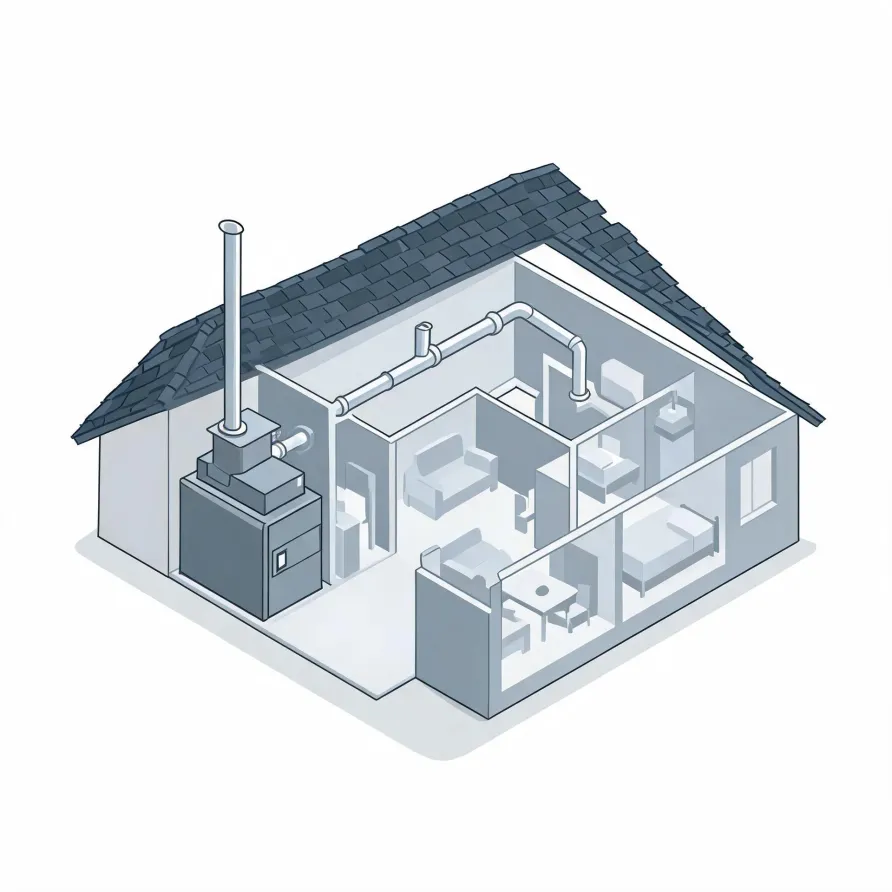
The furnace itself sits in a mechanical room, basement, or utility closet and is the unit that generates heat. Inside it, the heat exchanger is the piece a contractor reaches for first when something is wrong. A cracked exchanger lets combustion gases into the living space; a failed one means no heat at all. The burners, which fire inside the exchanger, and the igniter, which starts them, are the other components a contractor checks early.
The blower motor sits inside the furnace cabinet and pushes conditioned air out through the supply side of the system. The flue pipe runs from the furnace to an exterior wall or roofline and carries exhaust gases out of the house. The control board ties the whole sequence together, and when it fails the furnace often does nothing at all despite the other components being intact.
The drawing shows a typical furnace layout, and a licensed contractor determines which parts and conditions apply to your specific system.
Find a contractor in Hettinger CountyHettinger County, by the numbers
148 severe weather events were recorded in Hettinger County, North Dakota between 2015 and 2024.
NOAA National Centers for Environmental Information, Storm Events Database, bulk CSV export, events 2015-01-01 through 2024-12-31.Half the homes in Hettinger County, North Dakota were built in 1964 or earlier (2020-2024 ACS 5-year).
U.S. Census Bureau, 2020-2024 American Community Survey 5-Year EstimatesHettinger County, North Dakota holds 1,444 housing units (2020-2024 ACS 5-year).
U.S. Census Bureau, 2020-2024 American Community Survey 5-Year EstimatesOwners occupy 76.8% of the occupied homes in Hettinger County, North Dakota (2020-2024 ACS 5-year).
U.S. Census Bureau, 2020-2024 American Community Survey 5-Year EstimatesCodes & Standards Covering Furnace Repair in Hettinger County, North Dakota5 sourced rules and standards
What happens when a contractor comes out to your home
Non-weatherized gas furnaces manufactured on or after November 19, 2015 must reach 80.0 percent AFUE.
Non-weatherized oil-fired furnaces manufactured on or after November 19, 2015 must reach 83.0 percent AFUE.
Mobile home gas furnaces manufactured on or after November 19, 2015 must reach 80.0 percent AFUE.
Non-weatherized gas furnaces manufactured on or after December 18, 2028 must reach 95.0 percent AFUE, up from the 80.0 percent minimum that applies to units manufactured before that date.
Licensing Rules for HVAC Work in Hettinger County, North Dakota
North Dakota requires a contractor licence once the cost, value or price of a job exceeds four thousand dollars, and an unlicensed contractor may not bring a claim or a lawsuit in a North Dakota court over the work.
Severe Weather Events in Hettinger County
Extreme weather puts real strain on furnace systems, and North Dakota winters leave little room for equipment that is already worn down. How hard the weather hits Hettinger County shapes how hard the furnaces here have to work.
148 severe weather events, 2015–2024. Source: NOAA National Centers for Environmental Information, Storm Events Database.