Why one room stays cold in a North Dakota winter

Step 1 of 3: Equipment

One room stays cold because it's losing the fight between how fast it loses heat and how much warm air your furnace can get into it. A room on a north wall, over a garage, or at the end of a long duct run cools faster and gets less airflow than the rest of the house. In a North Dakota winter, with the ground frozen and wind pulling heat out through every gap, that gap between the two only gets worse. Sometimes the duct to that room is too small, crushed, or disconnected somewhere in the attic or crawlspace. Sometimes the register is partly closed or blocked by furniture. Sometimes the furnace itself can't push enough air to reach every room evenly, especially if the system was sized for the house as a whole rather than for that one far corner. Whatever the cause, it's a fixable airflow and heat loss problem, not something you have to live with until spring.

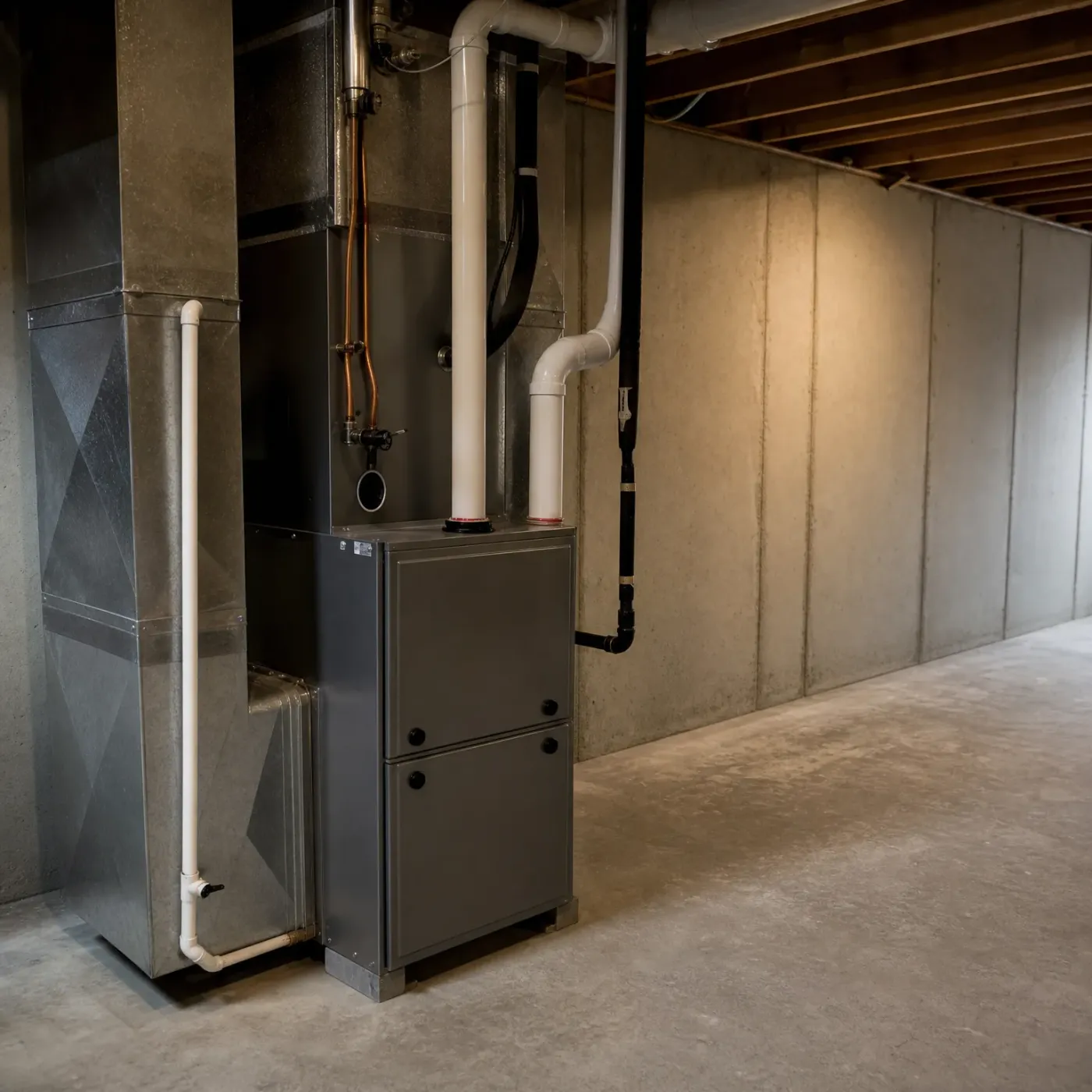
A gray high-efficiency furnace with white PVC vent pipes stands on a concrete pad in a basement, beside sheet-metal ductwork, copper piping and a poured concrete wall with wood framing at left.

The furnace is keeping up

If most rooms hold their temperature and only one falls behind, the furnace itself is probably fine. It's cycling on schedule and pushing air through the ducts the way it should. The problem is that one room's duct run or exposure is losing the argument.

A beige gas furnace in a basement with a metal flue pipe, galvanized sheet-metal ductwork to its left, and gas and water pipes along the concrete wall to its right.

The furnace is falling behind

If the whole house runs cold, not just one room, or the furnace runs long stretches without catching up, something in the unit itself is working harder than it should. A furnace losing that fight across the board is worth having looked at before a January cold snap finds the limit.

Is this the room everyone avoids now

You know the room. The door stays shut more than it used to. Socks on, maybe a space heater tucked in the corner. Touch the floor near the window and it's noticeably colder than the hallway. The vent might be blowing air that feels weaker than the ones in the rest of the house, or barely blowing at all. At night the thermostat says 70 and that room feels nowhere close. If people have stopped using it, or a kid's bedroom means an extra blanket every night, that's the room quietly losing. Left alone through a North Dakota winter, pipes running along that cold exterior wall are the thing worth watching.

A woman with dark hair in a bun wearing a cream knit sweater sits on a gray sofa in a bright living room, looking off to the side.
A woman wrapped in a knit blanket sits on a gray sofa in a living room, looking toward a bright window with houseplants and an armchair in the background.
A woman in a gray cowl-neck sweater sits on a light sofa with cushions, smiling and looking to the side, with a kitchen and window visible behind her.
A woman with dark hair in a bun, wearing a light linen shirt, sits on a sofa and looks to the side, with a window, houseplants and a kitchen with pendant lights blurred behind her.

Is It the Duct or the Furnace

Duct or room problem

  • A closed or half-closed vent in that room cuts airflow before it ever gets a chance to warm the space.
  • Long runs out to a bonus room or a room over the garage lose heat along the way, so what arrives is cooler than what left the furnace.
  • A crushed or disconnected duct behind a wall or under a floor sends warm air somewhere other than the room you're in.
  • A return vent blocked by furniture or a closed door stops that room from pulling its share of air back through the system.
  • Gaps around a window or an uninsulated wall let heat escape faster than the duct can replace it, especially with a North Dakota wind outside.
  • A damper in the ductwork, set wrong or stuck, can be sending more air to other rooms and less to this one.

Furnace problem

  • A furnace that's starting to struggle moves less air overall, and the room farthest from it or hardest to heat shows it first.
  • A dirty blower wheel or a weak blower motor pushes less air down every duct, not just the one feeding the cold room.
  • A failing inducer motor or a dirty flame sensor can cause short cycling, so the furnace never runs long enough to even out the house.
  • If the thermostat is in a different room than the cold one, the furnace shuts off once that room is satisfied, leaving the cold room behind.
  • A clogged filter restricts airflow at the source, so every room gets less heat, with the weakest room feeling it most.
  • If the furnace is working harder than it used to and the gas bill is climbing with it, the furnace itself may be losing capacity.
  1. Air leaves the furnace at full heat through the main trunk line.

  2. Branch ducts split that air off toward each room's vent.

  3. The farthest branch loses heat to the attic or crawlspace along the way.

  4. Less warm air reaches that room's register than the others get.

A gray high-efficiency furnace stands on a concrete basement floor beside sheet-metal ductwork, with white PVC vent pipes and a black flexible line running up to exposed wood floor joists, next to a wood-framed post against a concrete wall.
The furnace is set up right and the system is moving warm air the way it should.
A beige metal furnace with a louvered front panel stands on a concrete floor against a concrete wall, connected to galvanized sheet-metal ductwork and a metal pipe.
An older furnace like this can still heat the house fine, but a cracked duct or a failing part can rob just one room.

Winter nights average 4°F statewide

At 4 below zero outside most winter nights, your furnace has to push harder to get warm air all the way to that back room. A short duct run can make up the difference. A long one, or a closed vent, often can't.

NOAA nClimDiv 1991-2020 county normals weighted by homes

An older beige furnace with louvered front panels stands on a concrete basement floor beside galvanized ductwork, metal and plastic pipes, exposed wood framing, and a cylindrical water heater at right.
Before you get your furnace repair
A gray high-efficiency furnace in a basement with PVC vent pipes, sheet-metal ductwork, copper and insulated pipes, a water heater at left, and an unfinished wood-stud wall at right.
After you get your furnace repair

A pro who works on furnaces

A furnace repair tech can find out which of these is happening in your house with tools you don't have: a flow hood to check how much air that vent is actually pushing, a thermal camera to see where the duct run is losing heat before it ever reaches the room. Guessing at it room by room, vent by vent, burns a weekend. North Dakota winters don't leave much room for that. A room that's running cold in January isn't getting warmer on its own while you wait for a stretch of free time to look into it, and a space heater running in the corner all season costs you more than the fix would. Hand this one off. Once you send the request, it's someone else's job to track down why that room won't hold heat, and whether it's a closed damper, a bad duct run, or something the furnace itself is doing. You stop thinking about it. That's the part that changes first, before anything gets repaired.

What a duct run actually does

Warm air leaves the furnace at one temperature and loses some of that heat on the way to every room. A run that passes through an attic or crawlspace sheds more heat than one that stays inside the heated part of the house. By the time it reaches a far bedroom or a room over the garage, the air coming out of that vent can be measurably cooler than what's coming out of a vent ten feet from the furnace. That difference shows up as a room that never quite catches up, even on a mild night.

Why the thermostat can't see it

Your thermostat reads the air at one spot in the house, usually a hallway. It calls for heat until that spot hits temperature, then shuts the furnace off, whether or not every room got there first. A room with a long duct run or a half-closed vent might still be short on warm air when the furnace cycles down. The thermostat has no way to know that. It's doing its job correctly. It just can't fix a problem it can't measure.

An older woman with short gray hair in a cream cable-knit turtleneck sweater smiles while looking to the side in a wooden kitchen, with a round loaf of bread on a board in the foreground and a lit candle by a dark window.
A woman with dark hair in a bun sits wrapped in a chunky knit blanket on a couch with a child resting his head on her shoulder, eyes closed, beside a lit lamp and bookshelf indoors.

One Room, One Fix

  • One room losing the fight between heat loss and airflow is a duct or vent problem, not a sign your furnace needs replacing.
  • A flow hood and thermal camera find the exact point where that room is losing the battle, instead of guessing at it.
  • Closed vents, long duct runs, and ducts passing through unheated space each point to a different fix.
  • A furnace that keeps every other room warm on schedule is doing its job and doesn't need to be the focus of the repair.
  • Once a contractor matched to your house takes this on, you're done chasing the problem room yourself.
  • The fix is usually local to that one run or vent, not a system-wide overhaul.

The cold room isn't a mystery once you look at it the right way. It's losing heat faster than the duct feeding it can replace, whether that's a long run out to a bonus room, a vent that's half shut, or ductwork passing through a crawlspace before it ever reaches the floor register. The rest of the house holding steady tells you the furnace is doing its part. What's failing is local, somewhere between the trunk line and that one vent.

A flow hood and a thermal camera turn that guesswork into an answer. One measures what's actually coming out of the vent. The other shows where the duct is shedding heat before it gets there. Between the two, a contractor can point to the exact section of duct or the exact vent that's behind it, rather than replacing parts that were never the problem.

Once that's pinned down, the fix tends to stay small. Sealing a duct, insulating a run through the attic, opening a vent that got closed and forgotten. None of that touches the furnace itself, and none of it means tearing into the whole system.

Send the form and the search for who does this work is no longer yours to carry. A contractor matched to your house takes the room from here, and you can stop layering on socks and space heaters while you wait for an answer you already have.


A gray high-efficiency furnace in an unfinished basement with concrete walls and floor, connected to sheet-metal ductwork, white PVC vent pipes, and a black drain line beneath exposed wood joists.

Get your furnace to the right pro

Hand off the search

Send it once and finding someone is no longer on you.

No charge to send it. You decide if you hire them.