What temperature to set the heat in a North Dakota winter

Send the form and the furnace tune-up stops being something to remember.

Hand it off

Most homes in North Dakota do well around 68 degrees during the day, with a drop to 60 or so overnight. That holds through the stretch from November into March, when outdoor temperatures sit well below freezing for weeks at a time. Your furnace works harder the bigger the gap between inside and outside, so every degree you add to the thermostat pushes the burner to run longer and more often. Going much past 68 doesn't make the house noticeably warmer to live in, it just means the furnace cycles more to hold that number. Set back at night or when the house is empty, the furnace recovers that temperature quickly once gas heat is running, since it isn't fighting the cold as hard as a system that's been off for hours. Where the setting matters most is consistency. A furnace that holds one steady range all winter puts less strain on its igniter and blower than one pushed up and down by several degrees a day.

A man in a blue sweatshirt reclines with closed eyes in a brown leather armchair in a living room with a bookshelf, houseplant, sofa, window, and a side table holding newspapers and a dark mug.
A bearded man in a gray pullover reclines with closed eyes on a brown leather sofa in a sunlit room with a window, framed picture, potted plant, and a wooden cabinet holding papers and a dark mug.
A man in a gray sweater leans back with closed eyes in a brown leather armchair beside a wooden side table holding a dark mug and a folded newspaper, with bookshelves and a window seat behind him.
A man in a green sweater reclines in an armchair with his eyes closed and a slight smile, beside a window with plants, a small table holding a mug and folded newspaper, and bookshelves behind him.

Why does 68 degrees feel cold in a North Dakota winter?

You keep the thermostat at 68 like everyone says, but you're still reaching for a sweater. It feels off, like the number on the wall isn't telling the truth about the room. The air coming out of the vents doesn't feel wrong, but something about the room still feels colder than 68 should feel.

Cold floors and cold glass pull heat off your skin faster than the air can replace it

The thermostat measures air, not the walls or the windows around you. When it's well below freezing outside for weeks, as it does from November into March, your windows and exterior walls run colder than the air in the room, and your body loses heat to those cold surfaces by radiation. That makes 68 degrees of air feel more like 64 or 65. This is normal and it isn't a sign your furnace is falling short. A tech checking the system during a maintenance visit can confirm the furnace is producing the heat it should, which rules out the equipment as the cause of that chill.

A furnace in a dim basement with a dirty pleated air filter partially pulled out of its slot, beside a water heater and concrete walls and floor.

You're down in the basement on a Saturday afternoon in October, pulling the filter to check it before the cold really sets in. The light through the small window is already going thin and gray. You slide the filter the rest of the way out and it's gray too, matted with dust, the pleats packed flat in places. You hold it up and can't see through it. Outside, it's maybe 40 degrees, nothing yet, but you know what's coming by November. You set it on top of the furnace and stand there a second, filter in hand, thinking about the months ahead and whether this thing is ready for them.


It's off your list after this

Fill out one form instead of calling around for a furnace tune-up.

Asking costs nothing, and the choice to hire stays yours.

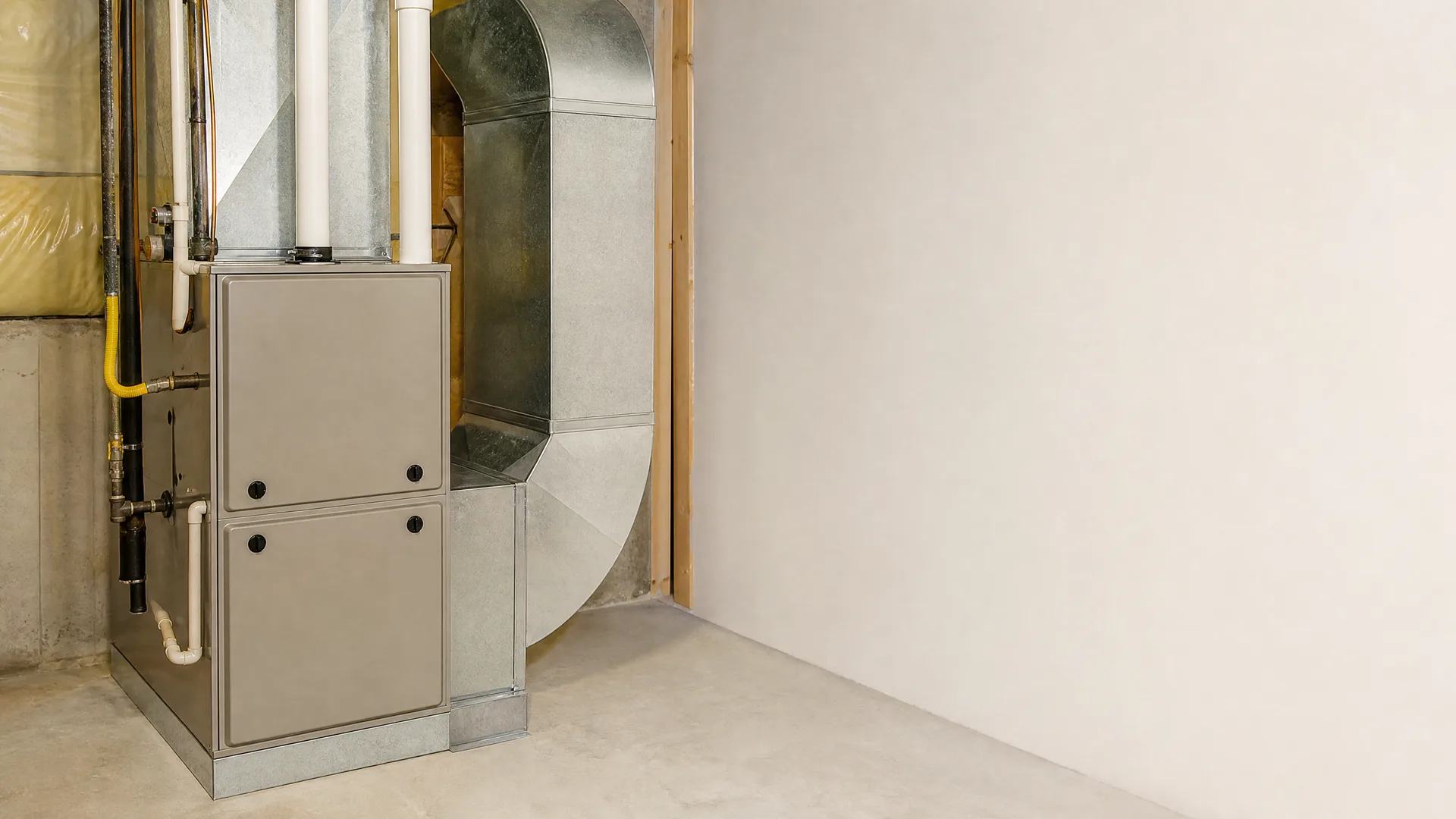
A gray high-efficiency furnace with white PVC vent pipes stands in an unfinished basement beside sheet-metal ductwork, gas piping, and insulated stud walls on a concrete floor.

The furnace holding steady

This is what a gas furnace looks like when it's keeping up with a North Dakota winter. The burners fire, the condensate drain carries off what the exhaust leaves behind, and the gas line feeds a clean, steady flame. Nothing strains to hold 68 degrees.

A beige sheet-metal furnace with a louvered upper panel stands on a concrete basement floor, connected to galvanized ductwork, white PVC vent pipes, and a metal gas line with an electrical box.

The furnace falling behind

This is the same job gone harder than it should be. Mid-efficiency furnaces like this one lean on the ductwork and the flue to move heat where it's needed, and when something's off, the unit runs longer to make up for it. A furnace due for a look before the cold sets in won't show it yet, but it's working for every degree.

An older gas furnace with louvered panels sits on a concrete pad in a basement, connected to sheet-metal ductwork and PVC and metal pipes, with a water heater and wooden stair framing in the background.
Before you get your furnace maintenance
A gray high-efficiency furnace with white PVC vent pipes stands beside galvanized sheet-metal ductwork in a basement with a concrete floor, with a wooden staircase and railing at left.
After you get your furnace maintenance
A gray furnace with sheet-metal ductwork, PVC vent pipes and a yellow gas line stands on a concrete basement floor beside wooden stair framing.

Running clean

This is a furnace keeping up with a North Dakota winter. The flue vents straight out through PVC, the gas line runs steady to the burners, and the ductwork overhead moves warm air to every room. Nothing here is working harder than it should at 20 below.

An older gas furnace with a louvered front panel stands on a concrete basement floor beside galvanized sheet-metal ductwork, a metal flue pipe, gas piping and a flexible conduit along a concrete wall.

Running strained

This furnace is doing the same job on a dirty filter or a flame sensor losing its read on the pilot. The burners cycle more to hold the same room temperature. By February you notice it in the gas bill before you notice it in the air.

Winter nights average 4°F statewide

At 4 below overnight, your furnace is running most of the night just to hold 60. It doesn't shut off and rest the way it might on a milder night. That's steady, long-cycle demand on the same burners and igniter for weeks running.

NOAA nClimDiv 1991-2020 county normals weighted by homes

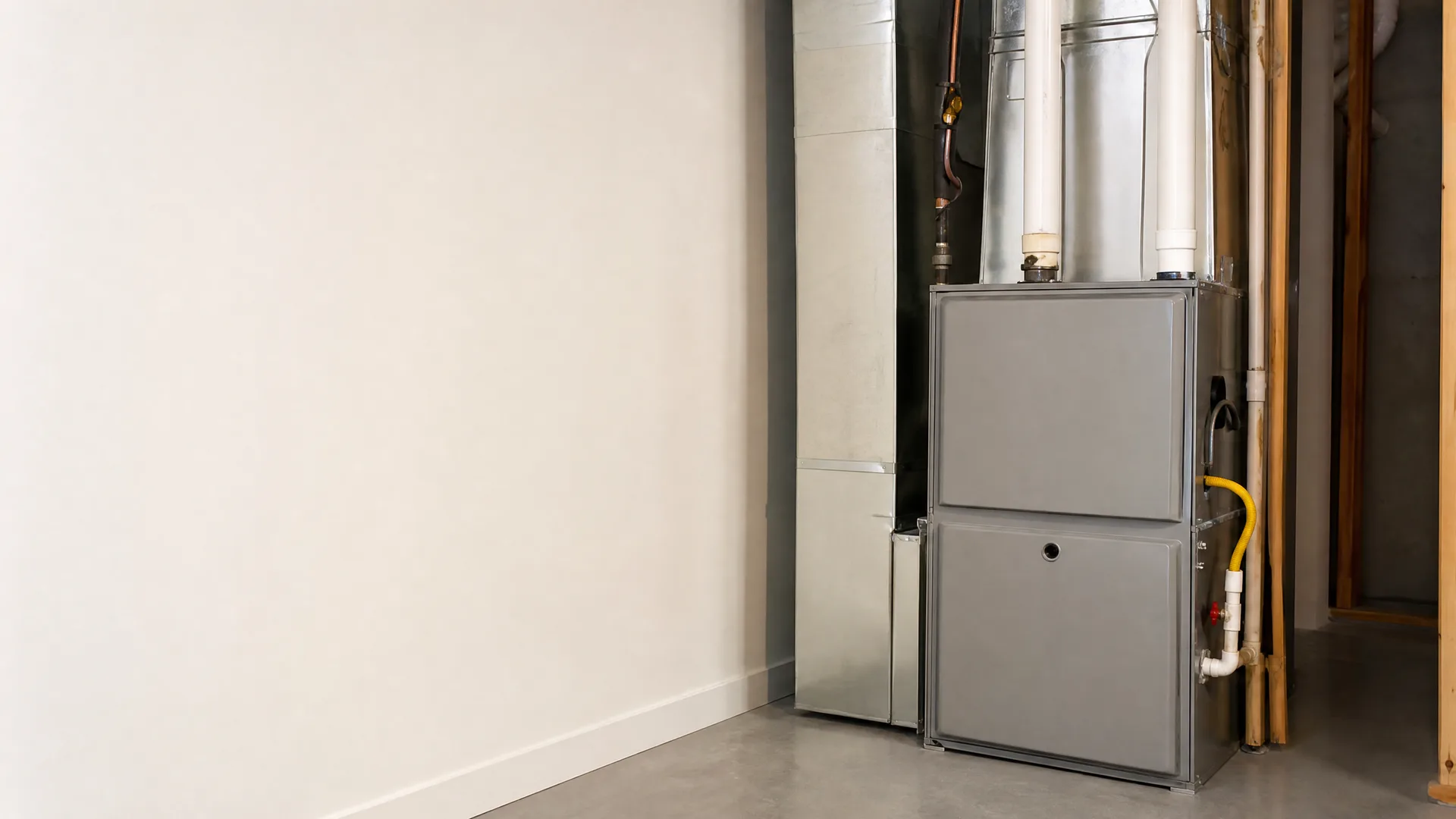
A gas furnace with sheet-metal ductwork, PVC vent pipes and copper and black piping stands against a wall in a basement with a bare light-colored wall and concrete floor.

Why one degree costs more here

Each degree you add to the thermostat adds load, but the effect is bigger once outdoor temperatures drop below zero for weeks at a time. A furnace sized for an average North Dakota winter already runs long cycles at 68. Push it to 70 or 72 and it has to recover that gap over and over, through January and February, with no break in the cold to let it catch up.

A gray furnace with attached sheet-metal ductwork, white PVC vent pipes, copper and yellow gas lines stands against a wall in a room with a plain white wall and concrete floor.

What a tune-up actually checks

A furnace maintenance visit looks at the things that wear from long, steady runtime: the igniter, the flame sensor, the inducer motor, and the heat exchanger. It also checks gas pressure and airflow across the coil. None of that shows up by looking at the thermostat. A furnace can hold 68 degrees and still have a flame sensor coated enough to cause a shutdown in the next cold snap.

A closed silver laptop and a glazed ceramic mug on a wooden table, with a blurred kitchen counter, potted plant, cutting board and window in the background.

68 during the day, 60 at night, and a furnace that's checked before January asks anything of it

That's the answer. 68 while you're up and moving, down to 60 once you're under the blankets, held that way from November through March. The number doesn't change because a cold snap hits zero or below. What changes is how long your furnace runs to get there, and that's a question for maintenance, not the thermostat dial.

If you haven't had anyone look at the furnace yet this year, that's the piece still open. Instead of searching around for a contractor, calling a few, explaining the same thing about your furnace each time, and sitting with quotes trying to compare one against another, you can send one form and let someone else sort out who's available and what it takes. The thermostat setting was the easy part. Getting a tech out before the hard stretch of winter is the part worth not putting off.

A living room corner with a beige sofa and cushion, a round wooden coffee table holding a pale ceramic vase of eucalyptus stems and a wooden bowl, and a curtained window with a potted plant above a latticed radiator cover in the background.
A gray-haired man with a beard in a blue button-placket shirt reclines on a couch with his eyes closed, beside a sunlit window with a green plant.
A woman in a cream knit sweater sits in an armchair with her eyes closed near a window showing yellow autumn foliage, with a mug on a round wooden side table beside her.

Furnace Maintenance

Stop chasing a furnace pro

Skip calling around to set up a furnace tune-up.

A black-framed smartphone standing upright against a plain white background, its screen filled with solid green.
Step 1 of 3: Equipment