Tell us about the job
Takes about a minute. No obligation.
A contractor quoting a furnace repair in Cavalier County starts with the components that cycle every heating season: the igniter, the burner, and the heat exchanger. Homes in Cavalier County, ND run heat about nine months a year, from September through May. That load falls almost entirely on those three parts, and by the time a homeowner calls for a repair, the igniter has fired thousands of times and the heat exchanger has expanded and contracted through hundreds of cold nights. Cracks, carbon buildup, and worn igniters are what a contractor finds first here, not because the equipment is cheap, but because the season is long and those parts bear the work directly.
Furnace repair here starts the same way it ends: with what the opened unit actually contains. Half the homes in Cavalier County, North Dakota were built in 1968 or earlier (2020-2024 ACS 5-year). A house built for a coal or oil system, later converted, carries the trace of every adaptation since, and a furnace sitting inside that history draws on parts from a narrower catalog than one in newer construction. When a burner assembly or heat exchanger fails, the contractor's first real question is whether a replacement component is still manufactured, or whether the repair becomes a procurement problem before it becomes a labor one.
The Parts of a Furnace a Contractor Checks First
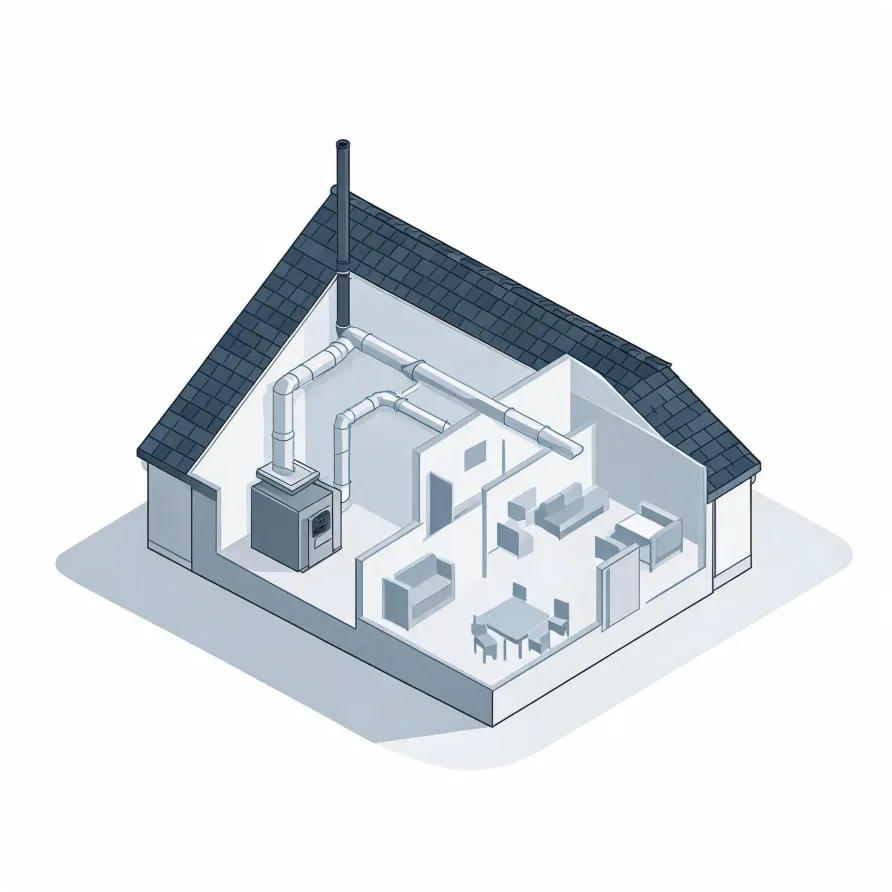
The furnace itself sits in a mechanical room, basement, or utility closet and is the core of the system. A contractor working a repair call starts here, looking at the heat exchanger, the burner assembly, and the igniter, since a crack, a dirty burner, or a failed igniter accounts for a large share of no-heat calls.
The blower motor and its fan wheel sit inside the furnace cabinet and push conditioned air out through the supply side of the house. The flue pipe runs from the furnace to an exterior vent, and the gas valve and pressure switches connect to the burner controls. A failed blower, a blocked flue, or a faulty gas valve each produces its own symptom, which is what a contractor is reading when the inspection begins.
The drawing shows a general layout of these components, and a licensed contractor determines what applies to the specific equipment and configuration in your home.
Find a contractor in Cavalier CountyCavalier County, by the numbers
156 severe weather events were recorded in Cavalier County, North Dakota between 2015 and 2024.
NOAA National Centers for Environmental Information, Storm Events Database, bulk CSV export, events 2015-01-01 through 2024-12-31.Half the homes in Cavalier County, North Dakota were built in 1968 or earlier (2020-2024 ACS 5-year).
U.S. Census Bureau, 2020-2024 American Community Survey 5-Year EstimatesCavalier County, North Dakota holds 2,109 housing units (2020-2024 ACS 5-year).
U.S. Census Bureau, 2020-2024 American Community Survey 5-Year EstimatesOwners occupy 81.3% of the occupied homes in Cavalier County, North Dakota (2020-2024 ACS 5-year).
U.S. Census Bureau, 2020-2024 American Community Survey 5-Year EstimatesCodes & Standards Covering Furnace Repair in Cavalier County, North Dakota5 sourced rules and standards
What HVAC Repair Looks Like in Cavalier County
Non-weatherized gas furnaces manufactured on or after November 19, 2015 must reach 80.0 percent AFUE.
Non-weatherized oil-fired furnaces manufactured on or after November 19, 2015 must reach 83.0 percent AFUE.
Mobile home gas furnaces manufactured on or after November 19, 2015 must reach 80.0 percent AFUE.
Non-weatherized gas furnaces manufactured on or after December 18, 2028 must reach 95.0 percent AFUE, up from the 80.0 percent minimum that applies to units manufactured before that date.
Licensing Rules for HVAC Repair in Cavalier County, North Dakota
North Dakota requires a contractor licence once the cost, value or price of a job exceeds four thousand dollars, and an unlicensed contractor may not bring a claim or a lawsuit in a North Dakota court over the work.
Severe Weather Events in Cavalier County
North Dakota weather puts real strain on furnaces, and Cavalier County gets its share of conditions that push heating systems hard. How often that happens locally shapes how much wear a furnace takes and how quickly repair needs build up.
156 severe weather events, 2015–2024. Source: NOAA National Centers for Environmental Information, Storm Events Database.